Olukoyede Pushes Prevention in Anti-Graft Fight
The Executive Chairman of the Economic and Financial Crimes Commission, Mr. Ola Olukoyede, has reaffirmed the Commission’s shift toward proactive prevention as a central strategy in Nigeria’s fight against corruption.
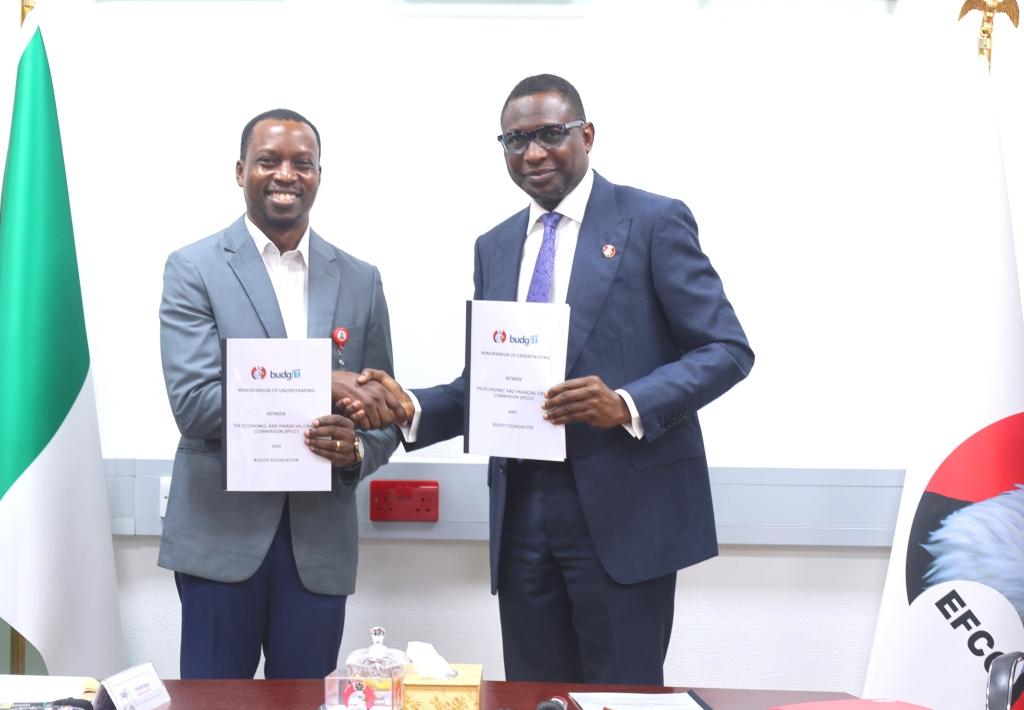
Olukoyede made this known on Thursday, February 19, 2026, at the EFCC Corporate Headquarters in Jabi, Abuja, during the signing of a Memorandum of Understanding (MoU) between the Commission and BudgIT Foundation.
He stressed that anti-corruption efforts must go beyond investigation and prosecution, emphasizing the need for early risk detection and institutional safeguards to prevent public funds from being looted in the first place.
“Coming to this office, I told the Senate during my confirmation that we can do things better. We do not necessarily have to wait for money to be stolen before we act,” Olukoyede said.
The EFCC Chairman disclosed that he had presented lawmakers with an analysis of funds lost to procurement fraud in a particular year, highlighting what such resources could have achieved if properly utilized.
“That resolve led to the establishment of a Directorate of Fraud Risk Assessment and Control within the EFCC,” he explained. “It is not enough to track stolen funds; we must stop them from being stolen in the first place.”
According to him, the Directorate has already recorded notable successes, preventing “tens of thousands, if not hundreds of millions of naira” from being siphoned in a recent operation.
Olukoyede further underscored the need for vigilance at the budget implementation stage, insisting that agencies must interrogate processes and ask critical questions once funds are appropriated for projects.
“If money is budgeted for a project, we must ask questions. What is happening to it? We should not wait until the project fails before we move,” he said.
Speaking at the event, Deputy Country Director of BudgIT, Vahyala Kwaga, described the MoU as both symbolic and strategic, noting that partnerships remain one of the most effective tools in combating corruption.
“Sometimes it is not about pointing fingers but about creating relationships,” Kwaga said, adding that collaboration between civil society and government institutions can foster reforms through shared ideas and perspectives.
Also speaking, Emmanuel Uche, Project Manager, Anti-Corruption, RoLAC, commended Olukoyede’s leadership, describing it as transformative and capable of restoring Nigeria’s credibility in the global financial system.
He noted that recent reforms have begun to yield positive outcomes, including renewed acceptance of Nigeria within the international financial community.
The MoU between the EFCC and BudgIT is expected to deepen collaboration in promoting transparency, strengthening preventive frameworks, and enhancing accountability in public finance management.