CJTF Funding: Umiaghwa Monarch Seeks Govt Intervention
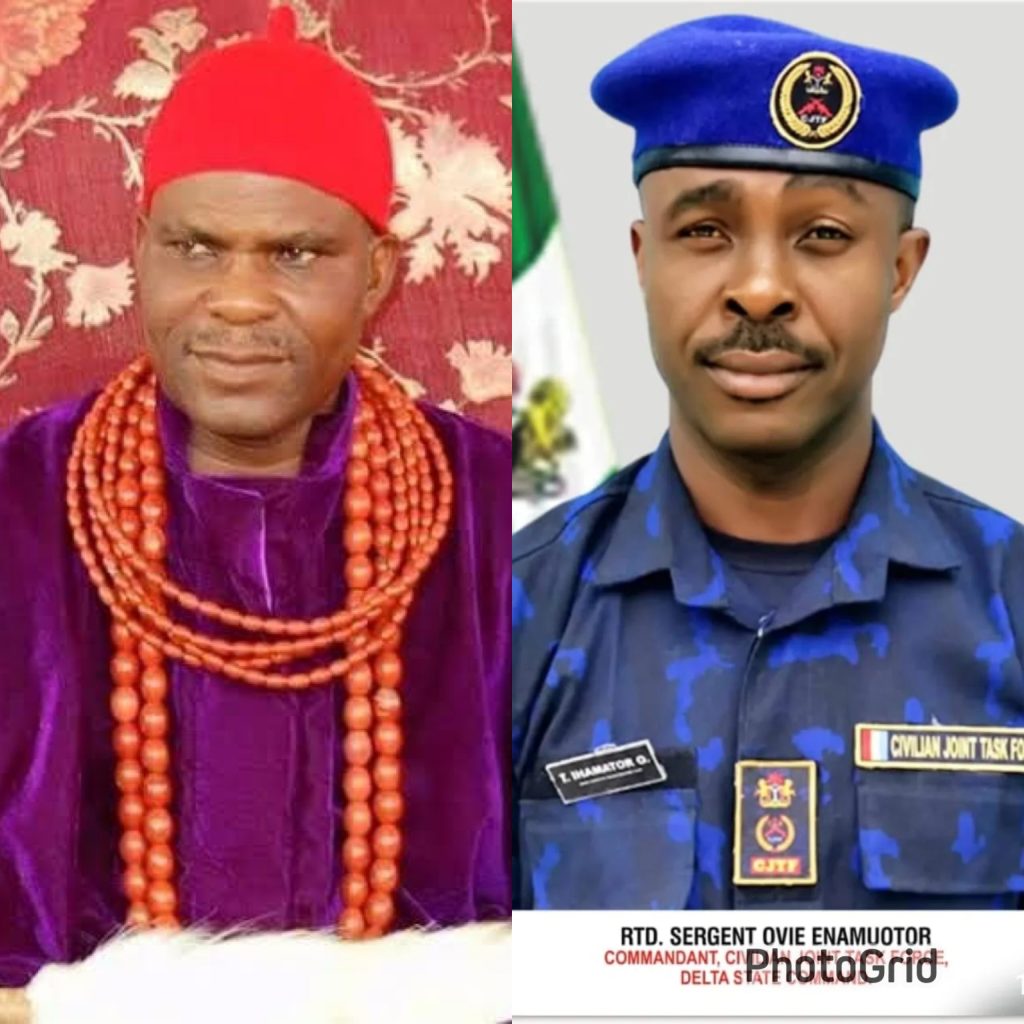
The Ovie of Umiaghwa-Abraka Kingdom, His Royal Majesty, Air Vice Marshal Lucky Ochuko Ararile (rtd), has raised concerns over the operational structure, funding and welfare of members of the Civilian Joint Task Force (CJTF), urging the government to properly define and support the outfit.
The monarch spoke when the Delta State Commander of the CJTF, retired Sergeant Ovie Enamuotor, led members of the organisation on a courtesy visit to the traditional ruler.
Speaking during the visit, the retired Air Vice Marshal recalled that during his time in service, civilians contributed to security efforts mainly as informants, logisticians and in other supportive capacities, rather than operating alongside security personnel on the frontline.
He said he was yet to see a clearly defined structural framework outlining how the CJTF was expected to operate, particularly regarding its relationship with conventional security agencies.
“During our time, we didn’t have CJTF working with us, but we had civilians working for us either as informants or logisticians and various other ways. But we didn’t have them working with us on the frontline. I am yet to see any paper or structural organisation on how you people are supposed to be operating,” he said.
The monarch also questioned whether CJTF personnel were authorised to carry weapons, stressing the need for clarity in the responsibilities and statutory roles of different security organisations.
He argued that some of the responsibilities being undertaken by the CJTF appeared to overlap with the functions traditionally associated with the Nigeria Security and Civil Defence Corps (NSCDC).
“Are you supposed to be carrying weapons? What you are doing is what the Civil Defence ought to be doing because that is the original idea,” he said.
According to him, rather than continuously creating new security outfits whenever manpower shortages arise, government should strengthen existing security agencies by recruiting more personnel and providing them with the necessary resources.
He cited the proliferation of different security organisations as a concern, recalling an occasion when members of another security organisation approached him.
“I know some other people came to see me, Peace Corps of Nigeria. When they came to see me about two years ago, I said to myself that if we continue like this, more corps will be coming. Instead of addressing the issue, this is the problem that we have; these are the manpower requirements, recruit more people and face the job,” he stated.
The traditional ruler said the continued establishment of separate security outfits could eventually result in a situation where almost every Nigerian belongs to one security organisation or another, rather than government adequately strengthening the established agencies.
‘How Are You Funded?’
The monarch, however, acknowledged the efforts of the CJTF and noted that government recognition of the organisation made the issue of funding and welfare particularly important.
“But now that you have been doing the job, the government has recognised you, and I hope they are funding you. Or how are you funded?” he asked.
Ararile expressed concern over the reported absence of regular salaries, housing support and insurance for CJTF personnel, particularly given the risks associated with security operations.
He questioned how members, many of whom have families to cater for, were expected to sustain themselves while performing duties that serve public security interests.
“Funding is always the problem. A government cannot set up an outfit and be depending on philanthropists. You don’t have a salary, even insurance, so how do you live?” the monarch asked.
He further questioned whether CJTF members were expected to provide their own accommodation and meet other expenses without government support.
“I don’t know how they want you to work,” he added.
The monarch observed that many CJTF personnel were married and therefore had responsibilities to their families, stressing that government should either adequately fund an organisation performing public functions or reconsider the arrangement.
“Because I can see most of you are married, is that how they expect you to take care of your families? If you are doing government work, the government has to pay for it. If they cannot pay for it, they should just leave it,” he said.
CJTF Commander Explains Operations
Responding to the monarch’s concerns, the Delta State Commander of the CJTF, retired Sergeant Ovie Enamuotor, explained that the organisation currently relies on approved local weapons in carrying out its operations.
He informed the monarch that the CJTF presently has no budgetary allocation from government, explaining that its activities are sustained largely through donations and support from philanthropists across the country.
Enamuotor said the organisation’s dependence on donations had become necessary to enable its personnel to continue carrying out their responsibilities despite the absence of dedicated government funding.
The commander also addressed concerns about the character and background of CJTF members, stating that the personnel are responsible members of their respective communities.
According to him, members of the CJTF have traceable occupations and sources of livelihood through which they support themselves and their families.
He explained that the personnel do not depend solely on CJTF activities for their livelihood, but voluntarily contribute their time and efforts towards assisting with security operations in their communities.
The engagement provided an opportunity for the traditional institution and the CJTF leadership to discuss the challenges surrounding community-based security, particularly the need for clear operational guidelines, adequate funding, equipment and welfare support.
The monarch’s concerns also underscored the broader question of how community-based security initiatives can complement conventional security agencies without creating overlapping responsibilities or uncertainty over operational authority.
For the CJTF, the explanation by its Delta State commander highlighted the practical realities confronting its personnel, including the absence of a dedicated budget and reliance on voluntary contributions and philanthropic support.
The meeting therefore brought into focus the need for clearer institutional arrangements and sustainable support for community security initiatives, particularly as security challenges continue to require collaboration between conventional security agencies, community stakeholders and local security structures.