Akpoturi’s Inaugural Lecture Redefines Nigeria’s Oil Wealth: From Source Rock to Revenue
By Professor Peters Emuobosa Akpoturi
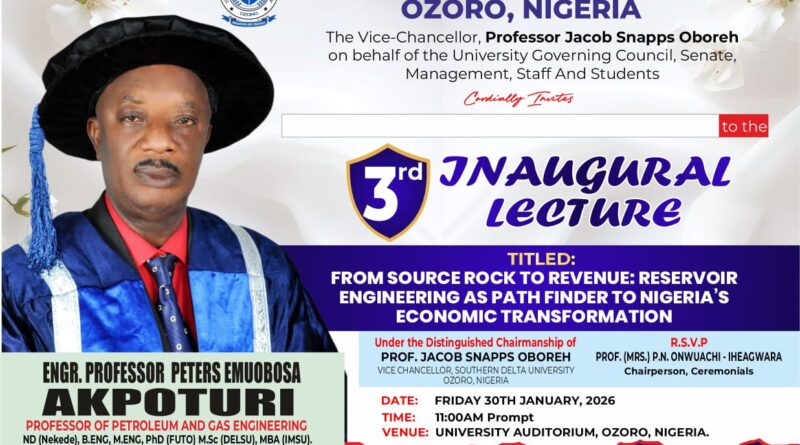
The inaugural lecture delivered at Southern Delta University, Ozoro, by Engr. Professor Peters Emuobosa Akpoturi, Professor of Petroleum and Gas Engineering, offers a timely and intellectually rigorous intervention in Nigeria’s long-running debate about resource wealth and economic underperformance. Titled “From Source Rock to Revenue: Engineering as Pathfinder to Nigeria’s Economic Transformation,” the lecture reframes Nigeria’s hydrocarbon challenge not as a question of abundance, but of engineering conversion, value optimization and long-term stewardship.
At the heart of Professor Akpoturi’s analysis is a powerful assertion: natural resources do not automatically translate into national prosperity. Rather, prosperity emerges when scientific understanding, engineering discipline and policy coherence converge to convert geological endowment into sustainable revenue. In this sense, reservoir engineering is positioned not merely as a technical specialty, but as a strategic economic enabler.
Nigeria, with over 57 billion barrels of proven oil reserves and more than 300 trillion cubic feet of natural gas, remains one of Africa’s most resource-rich nations. Yet, as the lecture underscores, the paradox of underdevelopment persists. Professor Akpoturi argues that the explanation lies beyond politics alone and squarely within the mechanics of how hydrocarbons are transformed from subsurface molecules into producible, monetized reserves. This conversion pathway, he emphasizes, is the domain of reservoir engineering.
Using the Niger Delta petroleum province as a reference model, the lecture traces the journey from Akata source rocks, through Agbada reservoirs, to surface production and national revenue. While geology explains where hydrocarbons exist, reservoir engineering determines how much can be recovered, how efficiently, and for how long. Fields such as Bonga, Agbami, Forcados, Bonny and Okan are cited as practical demonstrations of how engineering decisions on pressure maintenance, well placement and recovery mechanisms directly shape production outcomes and revenue profiles.
The lecture is particularly critical of Nigeria’s historical emphasis on rapid production following discovery, often at the expense of long-term reservoir surveillance and dynamic modeling. This approach, Professor Akpoturi notes, has contributed to early water breakthrough, bypassed oil and recovery factors that trail global benchmarks. With many Niger Delta fields now mature and water-cut dominated, average recovery factors remain between 20–30 per cent, leaving substantial volumes of oil unrecovered.
Reservoir engineering, the lecture argues, provides the corrective lens. Through integrated modeling, production surveillance and enhanced oil recovery strategies, incremental recoveries of 10–25 per cent are achievable—figures that translate into billions of dollars in additional national revenue. In capital-intensive deepwater developments, even marginal improvements in recovery factor can justify major investment decisions and significantly alter fiscal outcomes.
Beyond field-level performance, Professor Akpoturi extends the relevance of reservoir engineering into the realm of national policy and governance. Accurate reserves estimation and decline forecasting underpin production sharing contracts, royalty regimes and long-term budget planning under Nigeria’s Petroleum Industry Act framework. In a resource-dependent economy, the credibility of these projections directly affects fiscal stability, foreign exchange earnings and macroeconomic resilience. Effective reservoir management, therefore, is framed as a pillar of national economic security.
The lecture also revisits the long-standing scientific debate on the origin of Niger Delta hydrocarbons, weighing biogenic and abiogenic theories. Drawing on extensive geochemical, biomarker and isotopic evidence, Professor Akpoturi reaffirms the dominance of an organic, sedimentary source-rock origin, particularly linked to mixed Type II and Type III kerogens. This clarification, he argues, is not merely academic; understanding petroleum origin is essential for guiding exploration strategies, reservoir characterization and recovery planning.
In synthesizing geology, geochemistry, engineering and economics, the inaugural lecture delivers a clear and forward-looking message: Nigeria’s path from resource abundance to sustainable prosperity is an engineered one. Reservoir engineering emerges as the critical bridge between subsurface potential and surface value, between discovery and development, and ultimately between hydrocarbons and human progress.
For policymakers, industry operators and academics alike, Professor Akpoturi’s lecture stands as both a diagnosis and a roadmap—one that places engineering excellence at the centre of Nigeria’s economic transformation agenda.
Presenting Akpoturi’s citation earlier, the University’s Public Relations Officer, Dr Florence, celebrated the remarkable academic journey and professional achievements of Professor Akpoturi Peters Emuobosa, a distinguished scholar of Petroleum Engineering.
“Born on December 12, 1974, in Warri, Delta State, Professor Akpoturi received his early education in Warri and Effurun before earning his BSc, MSc and PhD in Petroleum Engineering from the Federal University of Technology, Owerri (FUTO).
“His multidisciplinary academic background also includes a National Diploma from Federal Polytechnic Nekede, an MSc from Delta State University, and an MBA from Imo State University.
“He gained industry experience as a Reservoir Engineer with Shell Petroleum Development Company (SPDC) before embarking on a distinguished academic career spanning over two decades across several Nigerian tertiary institutions. He currently serves at Southern Delta University, Ozoro, having held leadership positions such as Head of Department, Acting Dean and Director.
“A prolific scholar, Professor Akpoturi has authored over 120 academic publications, including 59 papers in high-impact international journals, and six major books.
“He has supervised hundreds of undergraduate and postgraduate students, delivered over 100 conference presentations, and served as editor, reviewer, external examiner and NUC accreditation team member.
“Professor Akpoturi is a Fellow of the Nigerian Institute of Petroleum Engineers and the Nigerian Institute of Petroleum and Gas Engineers, and a member of COREN, NSE, SPE, Nigeria Gas Association and Environmental Society of Nigeria.
“His numerous honours include the SPE Honorary Award, TETFund Research Award, University of Witwatersrand Award, and the NAPPS Hall of Fame Award.
Beyond academia, he is a devoted family man, a practicing Roman Catholic, a member of the Rotary Club of Effurun, and an advocate of community service.”