Oruarivie: The Agony of a Community Laying the Golden Egg
As Oruarivie grapples with deteriorating roads, flooding and questions over government accountability, the community’s development crisis raises fundamental concerns about leadership, political representation and the price of being an economic asset without commensurate public investment.
Alhaji Matthew Ogune is the Publisher of Mo Media Headlines and an Abraka community advocate. He writes from Abuja.
Oruarivie’s Burden: When Community Wealth Does Not Translate Into Development
Oruarivie-Abraka, home to the popular Delta State University (DELSU), occupies a significant place in the social and economic life of Ethiope East Local Government Area of Delta State.
Yet, for residents struggling with deteriorating roads, flooding and inadequate infrastructure, the promise of development appears increasingly distant.
For more than two years we have carried the burden of community advocacy, calling for the rehabilitation of roads and schools and demanding greater government attention to Oruarivie.
What should ordinarily be a shared responsibility between community leaders, government officials and concerned citizens has, however, become a source of controversy.
Some power brokers, according to my experience, have interpreted these advocacy efforts as attacks on community leadership, while others have described my approach as too confrontational. But the central question remains: should the manner in which a concern is raised become more important than the suffering that necessitated the concern in the first place?
The situation in Abraka has been the subject of repeated public concern. In February 2026, residents appealed for urgent intervention on deteriorating link roads, including Bembo Road and the NUT axis, where rainfall reportedly made movement difficult.
Subsequent reports in July highlighted recurring flooding, waterlogged streets and homes, and the absence of adequate drainage infrastructure in parts of the university town.
These reports reinforce the need to treat Oruarivie’s infrastructure challenges as a public-interest issue rather than merely a disagreement among political actors or community stakeholders.
The Politics of Advocacy and the Cost of Silence
One of the greatest challenges confronting community development in Oruarivie is the tendency to politicise legitimate demands for public infrastructure.
When residents speak about bad roads, they are not necessarily campaigning against a political officeholder. When they demand functional drainage, they are not declaring allegiance to an opposition party. And when they ask questions about public expenditure, they are not automatically undermining traditional or political leadership.
They are exercising their right to demand accountability.
For me, the advocacy for Oruarivie has never been about settling political scores or advancing the interest of any particular political group. It is about the people, their welfare and the future of a community whose contribution to the wider society should be matched by visible development.
The suggestion that advocacy must be softened to accommodate the sensitivities of those in positions of authority raises a troubling question: if those who speak are silenced, who will speak for the residents whose homes are surrounded by floodwater and whose movements are disrupted by bad roads?
Confrontational advocacy, when grounded in facts, responsible communication and legitimate demands, can draw attention to issues that might otherwise be ignored. However, the objective must always remain constructive engagement, transparency and measurable results.
The people of Oruarivie should not have to choose between respecting their leaders and demanding development. Both are possible, and both are necessary.
A University Community, Yet a Struggle for Basic Infrastructure
There is an irony in the condition of a community that hosts a major state university but continues to grapple with basic infrastructure challenges.
DELSU has helped shape Abraka’s identity as an educational and commercial centre. Its presence attracts students, lecturers, traders, landlords, transport operators and other economic actors. This makes the surrounding communities important to the functioning of the university town.
Yet, when internal roads become difficult to navigate and drainage systems fail to manage rainfall, the consequences extend beyond individual households. Students struggle to access their destinations, businesses lose customers, transport operators incur additional costs, and residents are exposed to avoidable hardship.
The flooding crisis is particularly concerning. Where roads lack adequate drainage, rainfall can turn access routes into barriers, leaving residents struggling to reach their homes. For households already bearing the cost of poor infrastructure, every heavy downpour becomes another test of endurance.
The situation demands more than temporary interventions or promises made during political seasons. It requires a coordinated infrastructure plan that considers road construction, drainage, flood prevention and maintenance as interconnected responsibilities.
The Delta State Government’s own project-monitoring records show that road infrastructure works have been awarded in Abraka. For instance, the 1.283-kilometre Chief Ogefere Street, Eseme Street and Oswotu Close project was awarded in June 2026, with a recorded progress of five per cent at the time reflected on the portal.
This is an important distinction: the issue is not whether any road project exists anywhere in Abraka, but whether Oruarivie’s specific infrastructure needs are being addressed adequately, and whether the projects intended to benefit residents are being delivered in a timely and effective manner.
The people deserve clear information on project locations, timelines, funding, drainage provisions and implementation status.
Oruarivie and the Question of Local Government Accountability
At the centre of this development crisis is a fundamental question of local governance: what tangible benefits are residents receiving from the public resources accruing to Ethiope East Local Government Area?
Oruarivie is widely regarded by its people as a significant economic contributor to the local government.
Its commercial activities, population and university-linked economy make it a community whose development needs should command serious attention.
However, the claim that Oruarivie generates substantial revenue must be matched with verifiable fiscal information. The exact revenue attributable to the community, the local government’s expenditure within Oruarivie and the value of projects delivered over the past two years are matters that deserve transparent documentation.
Publicly available fiscal data provides a broader picture of Ethiope East’s allocations, but allocation figures alone cannot establish how much was spent in Oruarivie or whether the community received a fair share of infrastructure investment.
This is precisely why the people must begin to ask more structured questions.
How much has Ethiope East received in statutory allocations and other public revenue during the current administration?
What projects have been budgeted for Oruarivie, and which have been completed?
What funds have been allocated to road rehabilitation, drainage, schools and other essential infrastructure in the community?
What is the status of approved projects that have yet to commence or have stalled?
What mechanisms exist for residents to monitor project execution and report non-performance?
These are not questions intended to embarrass the local government chairman or any other public official. They are questions of public accountability.
The administration of Hon. Augustine Usinefe Ogedegbe should have the opportunity to provide a detailed account of its interventions in Oruarivie. If meaningful projects have been executed, the people deserve to know. If projects have been delayed, the reasons and timelines for completion should be made public.
But what cannot be acceptable is a situation where the people are expected to remain silent while their infrastructure challenges persist.
The Royal Institution Must Rise to the Occasion
At a moment such as this, the role of the traditional institution becomes particularly important.
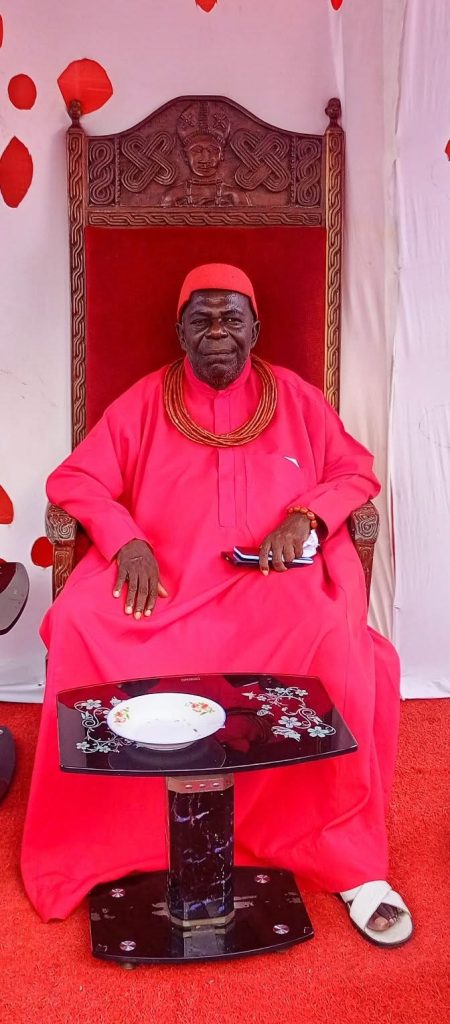
Okwu-Ojevworo, the revered royal father of Oruarivie, occupies a position of immense cultural significance and moral authority in the community. His leadership, alongside that of community elders, the President-General and other stakeholders, can help create a united platform for constructive engagement with government.
This is not a call for the traditional institution to become partisan or engage in political rivalry. Rather, it is an appeal for the palace to champion the collective welfare of its people and lend its voice to legitimate demands for development.
The royal institution should be at the forefront of a renewed community development agenda that prioritises roads, drainage, education, environmental protection and public accountability.
A united delegation of traditional rulers, community leaders, youth representatives, landlords, professionals and other stakeholders could formally engage the local government and Delta State Government, demanding a comprehensive assessment of Oruarivie’s infrastructure needs.
Such an initiative would give the community a stronger platform to seek answers, obtain documented commitments and monitor implementation.
The palace should not have to wait for political tensions to erupt before intervening in matters affecting the welfare of its people. Leadership is also about anticipating problems, bringing stakeholders together and ensuring that legitimate concerns receive the attention they deserve.
And if there are existing engagements, commitments or development plans that the wider community is unaware of, this is the time to communicate them openly.
The people need reassurance, not speculation. They need action, not silence.
Abraka 2027: Candidates Must Look Beyond the Ballot
As political activities gather momentum ahead of the 2027 Delta State House of Assembly election, the plight of Oruarivie residents presents an important test for those seeking to represent the restored Abraka State Constituency.
Candidates seeking the mandate of the people must understand that representation is not merely about political mobilisation, campaign structures, endorsements or the ability to attract crowds. It is also about understanding the everyday realities of the people and demonstrating a willingness to address them.
For residents battling flooding, deteriorating roads and other infrastructure challenges, the election season should provide an opportunity to demand clear commitments from all aspirants.
Where is their empathy for residents whose homes are affected by flooding? What plans do they have for improving the road network and drainage infrastructure? How will they use the legislative platform to attract government attention, monitor public projects and ensure that Oruarivie’s development needs are not relegated to the background?
These questions should be put to every candidate, regardless of party affiliation.
The people of Oruarivie must also resist the temptation to allow political differences to divide them on issues that affect their collective welfare. A road does not belong to a political party. A drainage channel is not an electoral favour. Access to basic infrastructure is not a reward for political loyalty.
Votes are earned through trust, engagement, credibility and a demonstrated commitment to public service. They are not an entitlement that candidates should expect simply because the election season has arrived.
For aspirants seeking to represent Abraka, this is an opportunity to demonstrate that their interest in the constituency extends beyond the ballot box.
The people should demand specific, realistic and publicly communicated commitments, while retaining the freedom to assess each candidate on their record, proposals and engagement with the community.
The Golden Egg Must Benefit the Community
The greatest tragedy for Oruarivie would be for it to continue contributing to the economic and social life of Ethiope East while its residents struggle to access basic infrastructure.
A community’s value should not be measured solely by the revenue it generates, the institutions it hosts or the economic activities it sustains. Its true development must also be reflected in the quality of life of its people.
Oruarivie cannot afford to normalise the current situation.
Neither can it afford to allow legitimate advocacy to be drowned in political suspicion, personal disagreements or institutional silence.
As a community advocate, I believe the time has come for a new approach — one built on unity, transparency, constructive confrontation where necessary, and sustained pressure for measurable development.
The traditional institution must lead. Community leaders must engage. Government officials must account for their stewardship.
Political aspirants must demonstrate empathy and offer tangible commitments. And residents must remain actively involved in the affairs of their community.
This is not about one individual, one political party or one administration. It is about the future of Oruarivie.
If Oruarivie is truly the golden egg of Ethiope East, then its people deserve to enjoy the benefits of the prosperity they help create.
The question is no longer whether Oruarivie deserves development. The question is how much longer its people must wait for it.
The agony of Oruarivie must not become its permanent identity.