When citizens become government: Igbakpa’s intervention and the failure of leadership on the Oghara–Mosogar road
By Alhaji Matthew Ogune
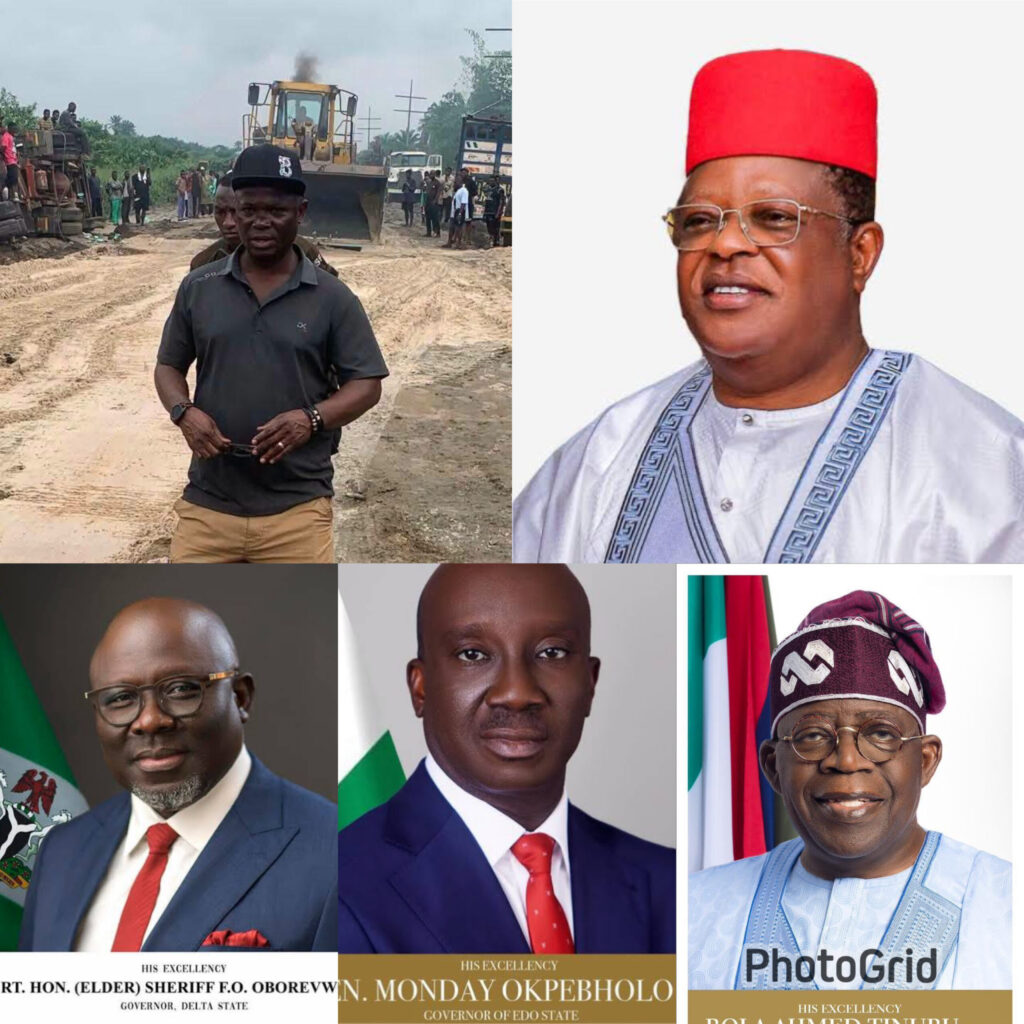
The intervention by Igbakpa in the failed portion of the Oghara–Mosogar road in Ethiope West Local Government Area of Delta State deserves commendation. At a time when motorists, commuters, traders and residents were being subjected to avoidable hardship, his decision to offer assistance toward restoring movement on the troubled section represents an important demonstration of compassion and community responsibility.
But beyond the appreciation of one individual’s intervention lies a much bigger and more uncomfortable question: Why should private citizens and community-minded individuals have to come to the rescue when governments at the federal and state levels have the constitutional responsibility, institutional machinery and public resources to provide and maintain critical road infrastructure?
That is the real story.
Oghara and Mosogar are not isolated settlements cut off from the national economy. Oghara is a major community in Ethiope West, an area with significant commercial, industrial, educational and oil-and-gas activity. The Oghara–Mosogar axis forms part of a wider transport corridor connecting communities in Delta and Edo states.
The deterioration of the road therefore cannot reasonably be dismissed as a minor community inconvenience. When such a strategic route fails, the consequences are felt far beyond the immediate communities.
Igbakpa’s gesture is commendable — but it should embarrass government
There is nothing wrong with an individual assisting his community. In fact, such interventions should be encouraged.
What should concern us, however, is the extent to which Nigerians have become accustomed to celebrating private interventions in areas where government ought to have acted long before a crisis developed.
A road does not collapse overnight.
It deteriorates gradually.
First come the potholes. Then erosion. Then weakened shoulders. Then flooding and drainage problems. Eventually, vehicles struggle to pass, commercial activity is disrupted and the road becomes a death trap.
The question is: Where were the authorities during all those stages?
The recent crisis on the Mosogar–Oghara stretch became so severe that motorists were reportedly stranded, passengers had to resort to motorcycles to navigate portions of the route, and commuters complained about increased transport costs, lost working hours and vehicle damage.
This is precisely where preventive governance should have taken over.
Instead, intervention came after the road had become a major crisis.
The Federal Government cannot hide behind jurisdiction
The strongest criticism must go to the Federal Government because the Benin–Sapele–Warri highway is a federal road.
The Federal Ministry of Works itself identifies the Benin–Sapele–Warri corridor as a federal route connecting Edo and Delta states. Its official records show that reconstruction of sections of the road has been undertaken under federal responsibility.
Therefore, while the Delta State Government deserves recognition for stepping in with emergency repairs, the larger question remains unanswered:
Why has a strategic federal highway been allowed to deteriorate to the point where emergency intervention becomes necessary?
Even more troubling is the fact that this is not a new problem.
The Niger Delta Development Commission reported in October 2024 that it had commenced emergency repairs on failed portions of the Warri–Benin road, including sections around Mosoga and other locations, following a presidential directive.
If emergency repairs were necessary in 2024 and another major failure occurred in 2026, then Nigerians are entitled to ask whether successive interventions are actually addressing the underlying engineering problem or merely postponing another collapse.
A federal government should not govern major highways through an endless cycle of failure, emergency repairs, promises, deterioration and another emergency repair.
That is not sustainable infrastructure management.
The Federal Government must explain what has happened to previous investments
The Federal Ministry of Works has previously documented reconstruction and rehabilitation projects along the Benin–Sapele–Warri corridor.
Yet the condition of portions of the route continues to generate serious public concern.
This raises legitimate accountability questions.
How much has been appropriated for the corridor?
How much has actually been released?
Which contractors have been mobilised?
What percentage of the relevant sections has been completed?
What are the contractual timelines?
Have contractors complied with maintenance obligations?
What has happened to previous emergency repair allocations?
And most importantly, when will Nigerians receive a durable road instead of another temporary patch?
These are not political questions. They are accountability questions.
Indeed, the issue has attracted criticism from within the National Assembly. Senator Adams Oshiomhole recently accused the Federal Ministry of Works of neglecting critical federal roads in Edo and Delta, arguing that existing roads were in terrible condition while new projects were being proposed.
That criticism should not be ignored.
Delta State Government: intervention is welcome, but leadership must go beyond palliative repairs
Governor Sheriff Oborevwori deserves credit for responding to the immediate crisis. In July 2026, he ordered emergency repairs on the failed Mosogar–Oghara section after the worsening condition caused serious traffic disruption and hardship.
That decision was necessary.
But it is not enough.
The Delta State Government cannot permanently solve a federal road problem through emergency repairs. The state’s intervention should be treated as a humanitarian and administrative response to an urgent crisis, not as a substitute for the Federal Government’s responsibility.
At the same time, Delta State has a legitimate responsibility to aggressively defend the interests of its citizens.
Governor Oborevwori should be asking Abuja hard questions.
Where is the permanent reconstruction plan?
What is the Federal Government’s timeline?
Which contractor is responsible?
How much has been committed?
Why are communities in Delta and Edo repeatedly subjected to the same cycle of road failure?
And why should state resources repeatedly be deployed to rescue infrastructure that is fundamentally under federal jurisdiction?
A governor should not merely repair the road whenever it collapses. He should use the political and institutional strength of his office to demand a permanent solution.
What about Edo State?
The Edo State Government also cannot completely wash its hands of the crisis simply because the immediate failed section discussed here is located in Delta State.
The road corridor connects both states and supports the movement of people, agricultural produce, petroleum products, manufactured goods and commercial vehicles between them.
Edo’s responsibility is therefore partly regional and political.
The Edo Government should be an active partner in demanding a comprehensive solution from the Federal Government rather than treating the problem as a Delta issue.
The Federal Ministry of Works has itself described the Benin–Sapele–Warri road as a federal project spanning Edo and Delta.
When a road corridor serves two states, governors should not wait for their respective portions to become impassable before acting collectively.
This is bigger than Oghara and Mosogar
The Oghara–Mosogar crisis exposes one of Nigeria’s most persistent governance problems: we react to infrastructure failure instead of preventing it.
Governments announce emergency repairs after citizens have suffered.
Officials visit failed roads after social media outrage.
Contractors mobilise after traffic has become unbearable.
Politicians make promises after vehicles have been damaged.
And when the road becomes temporarily motorable, attention moves elsewhere.
Until the next collapse.
This model of governance is expensive, inefficient and unfair to citizens.
The economic cost of bad roads is enormous. A damaged highway does not only inconvenience motorists. It increases transportation costs, raises the cost of goods, damages vehicles, wastes productive hours and can create opportunities for criminal activity when travellers are stranded.
For businesses operating along the corridor, unreliable transportation means higher operating costs.
For farmers and traders, it can mean spoiled goods.
For workers, it means lost time.
For students and patients, it can mean delayed access to essential services.
For ordinary families, it means paying more to travel a distance that should have been covered safely and efficiently.
Igbakpa has shown what leadership should look like — but citizens should not have to become government
The appreciation of Igbakpa’s intervention should therefore not be interpreted as an endorsement of government abdication.
Rather, it should serve as a mirror.
When an individual sees suffering and responds, he demonstrates compassion.
When government sees suffering and responds, it is fulfilling its responsibility.
There is a fundamental difference.
Private citizens can complement government.
They cannot replace government.
Community philanthropy can provide temporary relief.
It cannot substitute for proper engineering, procurement, supervision, drainage design, quality control and long-term maintenance.
That is why Igbakpa’s intervention deserves praise — while government’s failure deserves scrutiny.
The road requires a permanent solution
The immediate repairs are welcome, whether undertaken through the Delta State Government, private individuals such as Igbakpa, or other interventions.
But Nigerians must reject the idea that palliative work constitutes completion.
As civil society voices have also argued, emergency repairs on the Oghara–Mosogar section cannot by themselves resolve the larger problem of the Benin–Sapele–Warri highway.
The Federal Government must urgently undertake a properly engineered and fully funded reconstruction of the failed portions.
That reconstruction must include appropriate drainage, adequate road base, quality asphalt, shoulders, culverts and effective supervision.
There should also be publicly accessible information on the project cost, contractor, completion timeline and progress.
A final word to the three levels of leadership
To the Federal Government, the message is simple: take responsibility for your road.
To the Delta State Government, the message is equally clear: your emergency intervention is commendable, but do not allow palliative repairs to become the permanent policy. Fight for your people and demand reconstruction.
To the Edo State Government, the message is: this is a shared economic corridor. Join Delta in demanding a permanent federal solution.
And to Igbakpa, the message is one of appreciation: your intervention has demonstrated that compassion still exists in public life.
But perhaps the greatest lesson from the Oghara–Mosogar road is that Nigerians should no longer celebrate temporary relief as if it were development.
A pothole filled today is not necessarily a road reconstructed tomorrow.
A stranded motorist rescued today is not evidence of a functioning transport system.
And a private citizen coming to the rescue should not become an excuse for government to abandon its responsibility.
Igbakpa may have helped repair a failed road, but the bigger repair Nigeria needs is a repair of the culture of governance that allows critical infrastructure to fail before leaders act.
The people of Oghara, Mosogar, Ethiope West, Delta State and the wider Edo–Delta corridor deserve more than palliatives.
They deserve a road that works — and a government that works.
Alhaji Matthew Ogune
Journalist and Public Affairs Analyst & Publisher Mo Media Headlines
07035525757